
I just returned from my fourth trip to Santiago, Chile, where I’ve been working with teacher preparation programs interested in adopting practice-based teacher education (PBTE). Each visit has been energizing and thought-provoking, filled with rich conversations about what it means to prepare teachers well. But this time, my Chilean colleagues kept raising a question that I haven’t been able to stop thinking about: Is practice-based teacher education fundamentally a “U.S. model” of teacher preparation?
For those unfamiliar with the term, when we at TeachingWorks talk about practice-based teacher education, we mean pre-service preparation that focuses directly on the work of teaching. It’s an approach that deliberately builds capability with the primary instructional practices that new teachers need to learn. The curriculum integrates the specialized ways of knowing content and the foundational understandings—the skills, reasoning, and discretion—necessary to enact those core practices responsibly.
The interest in PBTE in Chile has been remarkable—hence the four visits. I’ve facilitated intensive workshops with nearly 200 Chilean faculty members across five or six institutions, and presented about PBTE in lecture formats to several hundred more. I know from these interactions that Chilean teacher educators are grappling with many of the same challenges we face in the United States: How do we better prepare teachers for the complex work of the classroom? How do we move beyond a theory-practice divide? How do we give beginning teachers a stronger foundation for their careers? These are universal questions in teacher education, which is part of what makes the “U.S. model” label feel off to me.
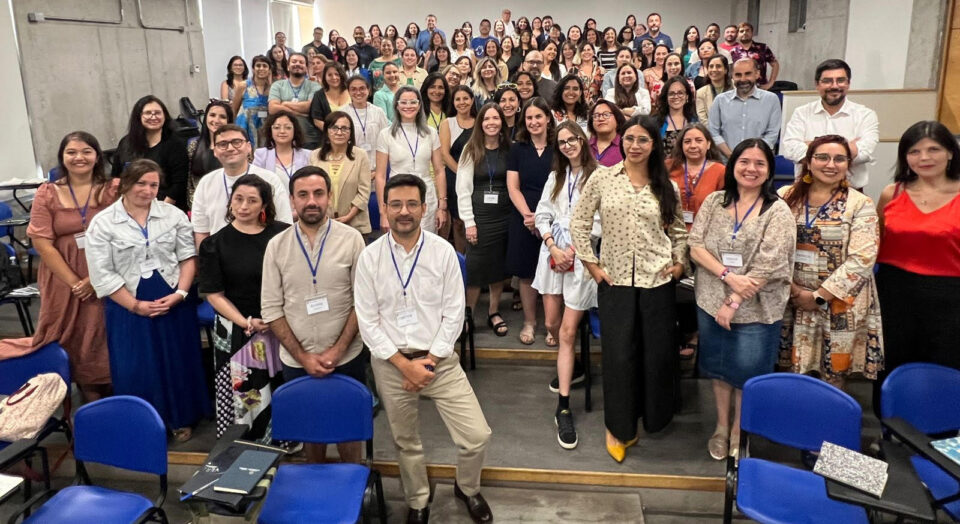
Francesca Forzani and Susan Atkins (center) are surrounded by participants in their January 2026 PBTE workshop at the Universidad San Sebastián in Santiago, Chile.
When I think about practice-based teacher education, I don’t see something uniquely American. Instead, I see a professional model—one that echoes what I suspect we would find in professional schools across many fields and many nations. Does medical education, for instance, look radically different depending on whether you’re training doctors in Ann Arbor, Amsterdam, or Adelaide? There’s attention to foundational knowledge, yes, but there’s also structured practice with core professional tasks, supervised clinical experiences, and deliberate skill development. The same is true for nursing programs, aviation training, even cosmetology schools, in the United States at least. These professional preparation programs share a common logic: identify the core work of the profession, break it down into learnable components, and provide structured opportunities for novices to develop competence before they practice independently.
So what, if anything, is distinctly “United States” about practice-based teacher education? I’m genuinely uncertain. Perhaps it’s the particular practices we’ve identified as core, and when and how those practices are enacted, or the specific pedagogies we use in teacher preparation (like rehearsals or decomposition of practice). But even these seem to be pedagogical tools that could work across contexts, not expressions of a uniquely American educational philosophy.
That said, one legitimate issue did surface repeatedly in Santiago: American classrooms look different from Chilean classrooms, and from classrooms in many other countries. Class sizes in the U.S. are generally smaller, for example. Our schools are organized differently, our policy contexts vary, and the populations we serve have different characteristics and needs. These differences matter, and they raise important questions about adaptation. If you’re preparing teachers for classrooms of 45 students rather than 25, does that change which practices are “core”? How much should practice-based teacher education be tailored to local classroom realities?
Of course, there’s plenty of variation in classrooms within the U.S., too. Class sizes do vary here, there’s huge diversity among student populations, and many regional and geographic factors create distinctive school and classroom contexts. Still, my instinct is that while the specific practices might need calibration for different contexts, the fundamental model remains sound across settings. Teaching everywhere involves explaining content, checking for understanding, responding to student thinking, managing a learning environment, and building relationships with students and families. These aren’t American tasks—they’re the tasks of teaching as a profession. The question isn’t whether these tasks exist in Chilean classrooms (they do), but rather how they manifest given different class sizes, curricular demands, and cultural contexts. Checking for student understanding, for example, can be carried out in a smaller classroom using labor-intensive strategies such as written “exit tickets,” whereas a larger classroom might require a different strategy, such as a poll.
I think practice-based teacher education is fundamentally a cross-national model that derives from the exigencies of classroom teaching as a profession, regardless of where that classroom is located. It’s rooted in a recognition that teaching is complex, skilled work that requires deliberate preparation, and that novices benefit from structured opportunities to develop competence in a supportive environment before taking on full responsibility for student learning. These realities transcend national boundaries.
But I’m genuinely curious what others think. Teacher educators in Chile, elsewhere in Latin America, and around the world: Does practice-based teacher education feel like a U.S. import to you, or does it resonate as a professional approach that could be adapted to your context? What would need to change to make it work well for the teachers you’re preparing? And for my U.S.-based colleagues: What do you think is culturally specific about how we’ve developed practice-based teacher education, and what aspects might translate more universally?
I don’t have definitive answers to these questions, but I’m convinced that wrestling with them will make all of our teacher preparation programs stronger. The conversations in Santiago reminded me that we have much to learn from each other—not just about practice-based teacher education, but about the fundamental work of preparing teachers well. I’m grateful for the opportunity to engage in this ongoing dialogue, and I look forward to hearing your perspectives.